Surprising statistic: even though major exchanges place over 95% of assets in cold storage, user-side account failures—lost 2FA, failed KYC selfies, and phishing logins—are still the single largest vector for retail losses. That fact resets the usual security conversation: institutional-grade custody on the backend does not eliminate front-door risks at login and verification. For a US-based trader, understanding OKX’s verification and login mechanisms is less about branding and more about operational control and risk layering.
This explainer walks through how OKX’s verification (KYC) and login systems actually work, what trade-offs they force on US users, where the system breaks down in practice, and simple decision rules you can use when logging in, moving funds, or choosing between the exchange and the non-custodial wallet. The goal is a sharper mental model so your next login—and any subsequent trade or withdrawal—has fewer hidden fragilities.
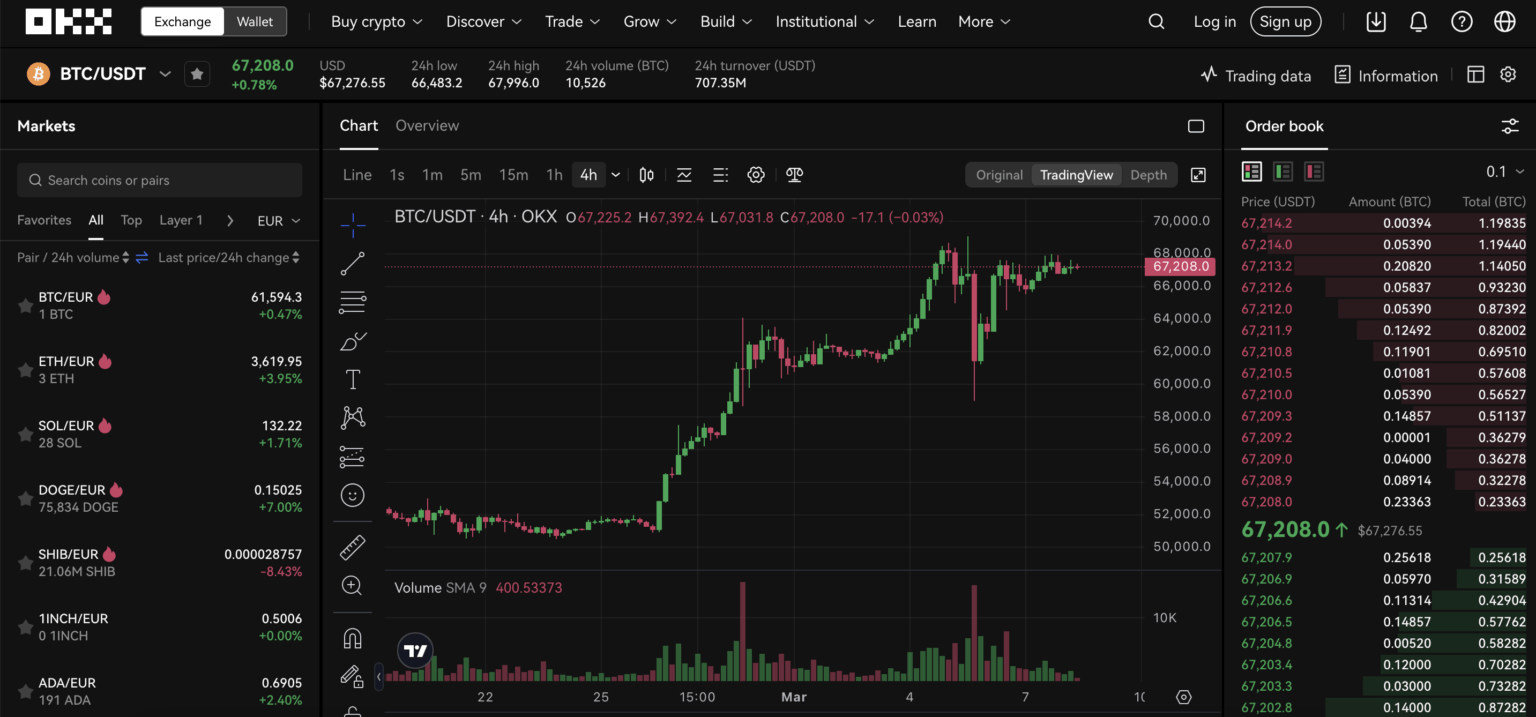
How OKX Verification Works: mechanism, not checklist
At its core, OKX’s identity verification (KYC) is a compliance mechanism to meet Anti-Money Laundering (AML) rules. Mechanistically, KYC does three things: (1) it ties an account to a government-issued identity document, (2) it binds that document to a live human through facial recognition liveness checks, and (3) it confers higher on-platform privileges (larger deposit/withdrawal limits, full access to derivatives, fiat gateways). For US users this is typically mandatory before you can move sizable fiat or access certain products.
This is important because verification is not merely gatekeeping; it’s an authorization layer that the platform uses to decide what automated controls to apply to your account. Verified accounts may have faster withdrawal approval or expanded products like margin and futures. Yet that power creates a trade-off: the more privileges you unlock, the more tempting your account becomes to attackers and the larger the consequences of a successful social-engineering attempt.
Login and Account Protection: layers and their failure modes
OKX combines military-grade server-side encryption, AI-driven real-time threat detection, and mandatory Two-Factor Authentication (2FA). Practically this means when you log in the platform checks device fingerprinting and suspicious behavior patterns before granting access. 2FA options include SMS, Google Authenticator, and biometric options on mobile. Each method has different failure boundaries: SMS is convenient but vulnerable to SIM-swapping; app-based authenticators are robust but require backup codes; biometrics are fast but tied to the device hardware and recovery path.
For US traders the sensible hierarchy is: hardware authenticator or app-based 2FA as primary, SMS only as a fallback, and biometrics only where you control device lifecycle. Critical limitation: if you lose the seed phrase for a linked non-custodial wallet or lose access to your 2FA method without backup, recovery can be slow or impossible. The platform’s AI threat detection reduces, but does not eliminate, the risk of credential stuffing or sophisticated phishing—human judgment still matters.
Exchange Account vs Non-Custodial OKX Wallet: clarify the boundary
OKX offers both a centralized exchange account and a non-custodial Web3 wallet where you control private keys via a seed phrase, with hardware wallet integrations (Ledger, Trezor). The decision is a classic custody trade-off: centralization buys convenience—faster trading, leverage up to 125x on certain derivatives, staking, and fiat rails—while self-custody gives absolute control and removes counterparty risk. Mechanistically, the exchange uses cold wallets (over 95% offline multi-signature cold storage) and Proof of Reserves to reduce custodial risk, but that does not transfer custody to you.
Non-obvious point: Proof of Reserves demonstrates that an exchange holds assets at a point in time, not that individual account metadata or withdrawal controls are invulnerable. Proof of Reserves helps answer “Do they have my funds?” but not “Can my credentials be misused?” If you rely on the exchange for custody, treat login hygiene as a form of micro-custody insurance: your login is the key that accesses the insurer’s vault.
Practical login and verification workflow for US traders
Step 1 — Prepare identity materials: have a government-issued ID and a clean background for the liveness check. Errors in the selfie or ID upload are common causes of delays. Step 2 — Choose 2FA carefully: prefer Google Authenticator or a hardware key; store backup codes offline. Step 3 — Link a non-custodial wallet if you use DeFi or want to isolate assets. Step 4 — Use device hygiene: keep the browser extension and mobile app updated, and only install the official Web3 extension when interacting with DApps. These steps reduce friction but also expose trade-offs—e.g., adding a hardware wallet increases security but slightly slows routine trades.
One operational heuristic: use the exchange account for active trading and a separate non-custodial wallet for longer-term holdings and DeFi interactions. Move funds between them using deliberate, confirmed transactions—never via links in unsolicited messages. When you receive a prompt to re-verify or to approve a login, pause and verify via a separate channel (official app or the single linked resource) before complying.
Where the system tends to break—and how to anticipate it
Primary breakdowns are social engineering, device compromise, and recovery missteps. Social engineering can bypass KYC if an attacker convinces support staff; device compromise can capture 2FA or seed phrases; recovery missteps occur when backup codes or seed phrases are stored digitally in insecure locations. Another practical fragility: delistings and product changes—like the recent, routine delisting of several small spot trading pairs—can require you to move assets quickly. If your verification status or withdrawals are limited during such a change, you may face forced trades or unexpected slippage.
Mitigation is procedural: maintain withdrawal whitelists when possible, keep a small on-exchange balance for trading, and hold the majority in a self-custodial wallet where you control the keys. Remember the trade-offs: whitelisting reduces convenience for speed of withdrawals; self-custody increases responsibility and risk of permanent loss if you mismanage your seed phrase.
Non-obvious insight: verification status is an active risk signal, not merely bureaucracy
Many traders treat KYC as an onboarding formality. A better mental model is to see verification status as a dynamic permission set: it controls what automated tolerances the platform will apply to your account during anomalous activity. If you’re verified, the platform may allow larger withdrawals after fewer manual checks—useful for rapid trading, risky if your account is compromised. Therefore, think about verification as a dial: you can increase convenience (and exposure) or reduce exposure (and convenience) depending on how you configure account security and withdrawal limits.
Decision rules—three simple heuristics
1) If you trade frequently and use margin, accept KYC but harden 2FA and use device isolation (dedicated browser profile or device). 2) If you’re primarily a DeFi user, prefer the non-custodial wallet and minimize on-exchange holdings; verify only to the level needed for fiat operations. 3) If you hold large sums for long-term, split custody: hardware wallet + exchange cold storage, and maintain documented, offline recovery procedures.
For step-by-step login guidance and the official entry points to the platform, refer to the exchange’s verified web login resource: okx.
What to watch next (near-term signals)
Monitor two categories of signals: platform housekeeping (delistings, new product rules) and regulatory signals. Routine delistings—such as the recent pruning of several low-volume spot pairs—are indicative of liquidity management, not systemic failure, but they can force rapid asset moves by traders who hold illiquid tokens. On the regulatory side, US policy changes to AML or custody rules could change verification granularity, KYC persistence, or third-party verification requirements. These would mechanically alter friction at login and the information required in verification.
Conditional scenario: if regulators demand more persistent on-chain linking of identity to tokens, expect increases in onboarding friction and potential shifts toward self-custodial solutions for privacy-conscious users. Conversely, if exchanges win clearer regulatory frameworks recognizing Proof of Reserves and strong custody practices, some friction might be reduced for verified traders.
FAQ
Q: Do I have to complete KYC to use OKX wallet features?
A: Not always. You can use the non-custodial Web3 wallet without full exchange KYC for many decentralized applications, but access to fiat on-ramps, certain derivatives, and larger withdrawal limits on the centralized exchange will require identity verification. This separation exists because the regulatory obligations apply more strictly to custodial services and fiat rails than to non-custodial wallet interactions.
Q: Which 2FA method is safest for a US trader?
A: App-based authenticators (Google Authenticator, Authy with secure backups) or hardware keys are generally safest. SMS is convenient but susceptible to SIM-swapping. Biometrics are convenient on mobile but rely on secure device management. The safest routine combines a hardware key for the exchange account, app-based backup, and offline storage of recovery codes.
Q: If OKX provides Proof of Reserves, does that mean my funds are guaranteed?
A: No. Proof of Reserves provides on-chain evidence that the exchange holds a specific aggregate of assets at a point in time. It does not guarantee operational continuity, nor does it remove login- or account-level risks. Consider it an important transparency signal about solvency, but not a substitute for good personal security practices.
Q: What should I do immediately after completing KYC?
A: Harden your account: enable a strong 2FA method, set withdrawal whitelist addresses if available, move large holdings to cold storage or a self-custodial wallet if not actively trading, and document recovery procedures offline. If you plan to trade, set position and risk limits consistent with your capital and the leverage products you intend to use.
Final takeaway: treat login and verification as operational controls rather than mere onboarding steps. They determine who can move your funds, how quickly, and under what scrutiny. Matching your verification choices and 2FA methods to your trading style—not vice versa—keeps risk proportional to the value you place on convenience and speed.
When in doubt, slow down: pause before you approve any unexpected login, re-check URLs and device prompts, and rely on isolated devices for high-value keys. That discipline is the single most effective defense against the human-driven attacks that remain the most common failure mode.